
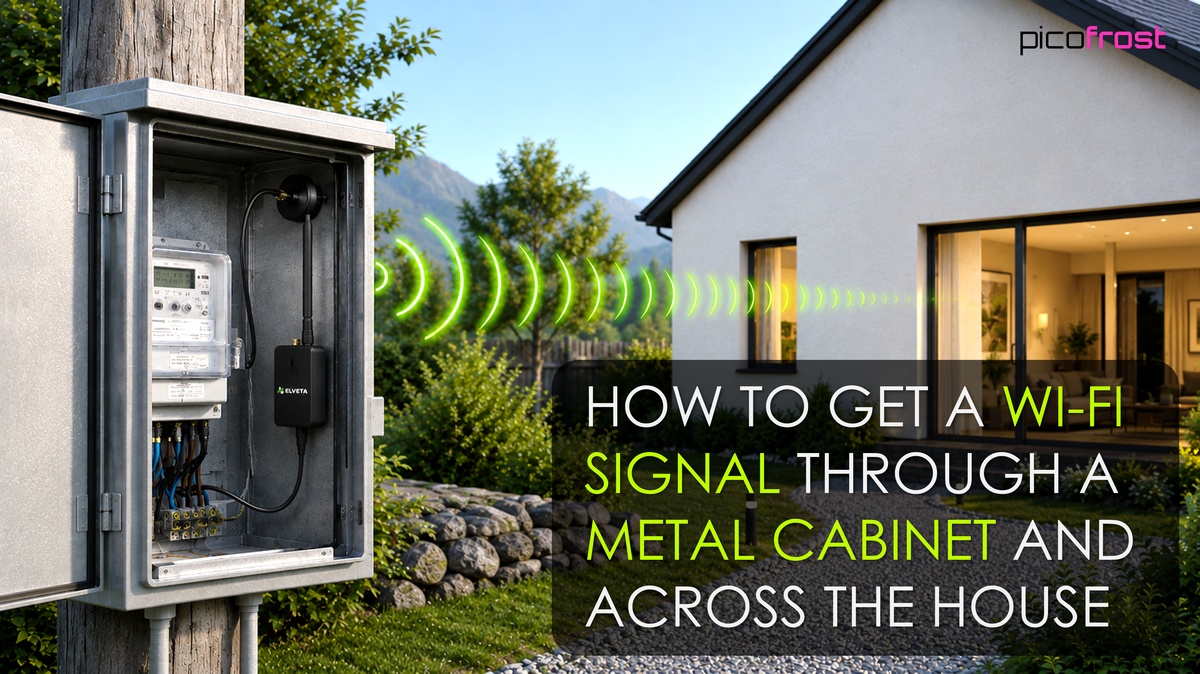
How to Get Reliable Wi-Fi From Inside a Metal Meter Cabinet
Connecting an IoT device to Wi-Fi sounds simple. Connecting one reliably from inside a metal meter cabinet, through several walls, or even from a meter cabinet on a pole outside the house is a very different engineering challenge.
Reliable connectivity is not determined by a single specification. It is the result of the complete radio system: transmit power, data rate, antenna gain and efficiency, receiver sensitivity, electrical noise, power management and - often overlooked - antenna placement.
Transmit Power Matters - But Power Is Limited
Higher transmit power can improve link margin and the ability to communicate over longer distances and through obstacles.
For a mains-powered device, operating the radio at high transmit power is relatively straightforward. An energy-monitoring device powered directly from an electricity meter presents a different challenge.
Meter interfaces such as P1 and HAN have strict limitations on how much power a connected device may draw. Wi-Fi transmission can create power peaks that are significantly higher than the device's average consumption.
The engineering challenge is therefore not simply to select a powerful Wi-Fi radio. The complete power system must be designed to provide the radio with sufficient peak power while staying within the electrical limits of the meter interface.
Sometimes Slower Wi-Fi Is Better Wi-Fi
For a low-power IoT device, maximum data throughput is rarely the goal. Link reliability is.
Lower Wi-Fi data rates can provide better receiver sensitivity and greater link margin. In a difficult installation, that additional margin can make the difference between an intermittent connection and a stable one.
There is a trade-off. Lower data rates keep the radio transmitting for longer, increasing the energy required for each transmission. A well-designed system therefore needs to balance data rate, transmit power, transmission time, and available energy.
Even slow Wi-Fi is fast. The amount of data being transmitted is small, so even at low Wi-Fi data rates, transmission time is short enough to provide a responsive real-time experience.
Get the Antenna Away From the Electronics - And Tilt It
A good radio deserves a good antenna.
Antenna efficiency and placement can have as much impact on connectivity as the radio itself. Separating the antenna from potential noise sources such as CPUs and DC/DC converters can significantly improve radio performance.
An external antenna also provides another important advantage: positioning. It can be moved, rotated, and tilted to achieve a better radio path.
In particularly challenging installations - for example, a metal meter cabinet mounted on a pole some distance from the house - an external antenna connection makes it possible to place a suitable weatherproof antenna outside the cabinet.
Reliable Connectivity Requires a Complete System Approach
There is no single specification that guarantees excellent Wi-Fi performance.
Reliable connectivity comes from optimizing the complete system: transmit power, receiver sensitivity, data rate, antenna efficiency, RF interference and electrical noise, power management, and physical antenna placement.
A few additional decibels of link margin can be the difference between a connection that works on the test bench and one that continues to work reliably through a metal cabinet, an extra wall, or a longer distance.
That is why good IoT connectivity is not about choosing the Wi-Fi chip with the most impressive specification.
It is about engineering the complete radio system.
Interested in discussing Wi-Fi, low-power IoT, or real-time energy data? Contact us at info@picofrost.com.
#EnergyTech #IoT #Wi-Fi #SmartMetering #Engineering
Originally published on LinkedIn.